Have you ever looked at the sweeping stairs in your foyer and wondered how to bring them back to life? We completely understand how overwhelming a curved staircase renovation can feel. The experts at Staircase Renovation Toronto provide curved stair restoration, radiused tread and stringer rebuilds, and continuous curved handrail fabrication right here in Toronto, ON.
This highly specialized work is backed by 22 years of hands-on experience across the GTA. Our process handles all the complex details for you:
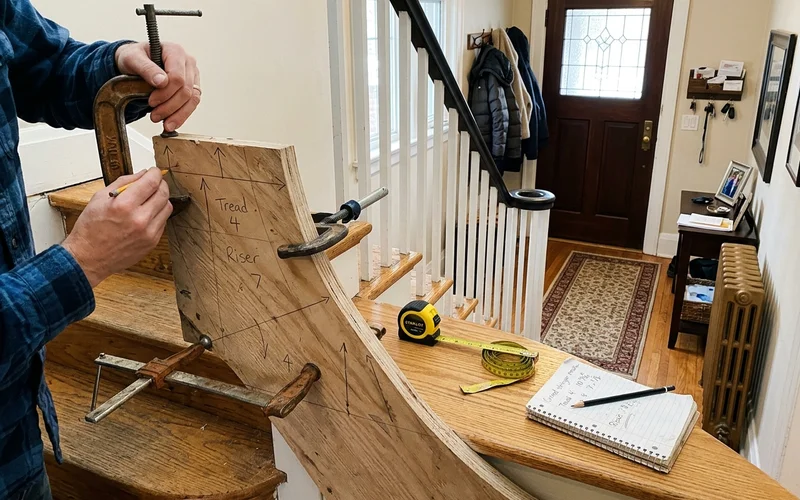
- Templating the exact radius directly on site.
- Forming custom-bent stringers where originals fail.
- Cutting each radiused tread to its own specific shape.
We then laminate a continuous curved handrail that perfectly follows the pitch around the turn, finishing it with a beautiful volute or gooseneck.
These sweeping stairs are common in older Rosedale, Forest Hill, Yorkville, and Kingsway homes.
Our project manager, Andriy Kovalenko, personally supervises every curved install to ensure quality. Timelines typically run three to six weeks depending on the exact radius of the curve. Pricing falls between $18,000 and $45,000 per staircase, driven largely by the radius and your choice of material.
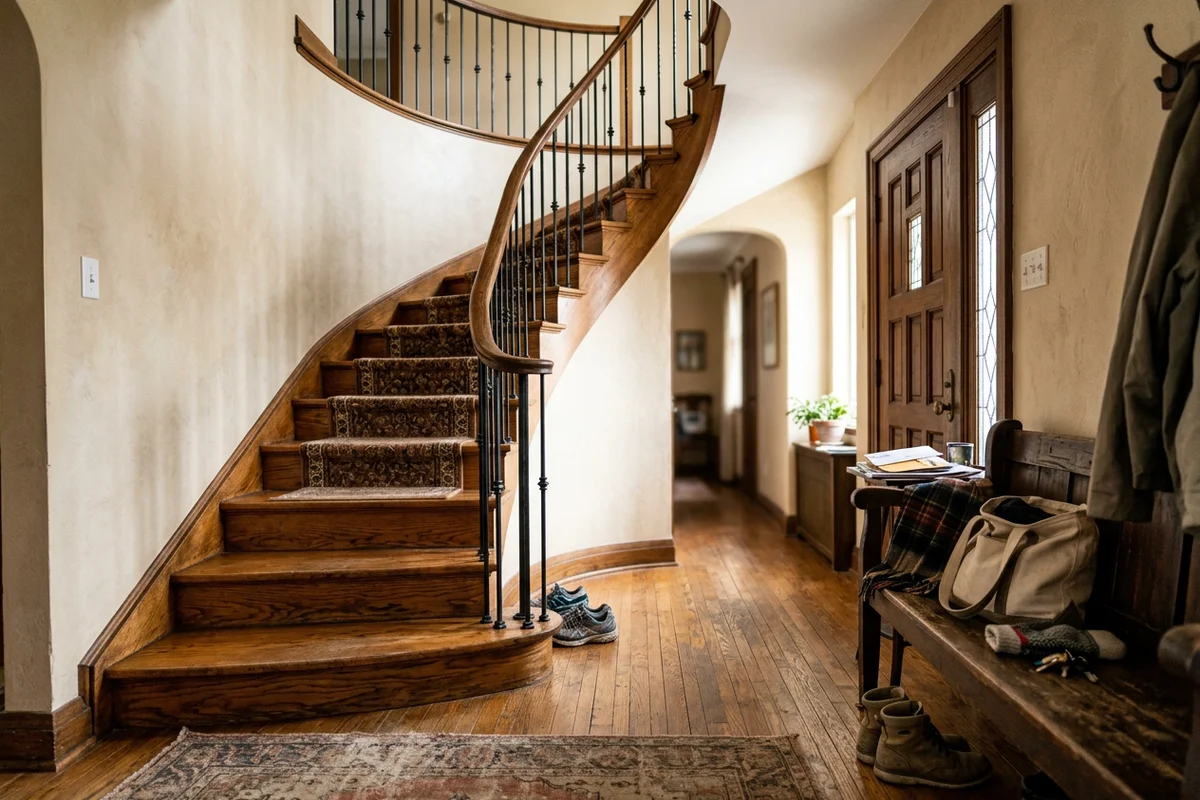
Marta and her family on The Kingsway had a beautiful oak staircase that had tired treads and a misaligned handrail. Andriy met with them on day one and explained it would be a six-week job.
The crew carefully templated every tread, kept the sound stringer on the wall side, laminated a new continuous oak handrail, and set iron balusters at their own angle along the curve. Our team finished this project exactly on schedule at $28,000. Her new rail lines up perfectly with the old curve all the way to the volute.
What Is a Curved Staircase Renovation?
A curved staircase turns elegantly as it rises, either as a gentle arc or a tighter spiral sweep. The inner and outer stringers require specialized bending, every tread is a slightly different wedge shape, and the handrail constantly changes pitch. Our approach to a renovation can mean anything from refinishing and adding new railings to rebuilding the stringers and treads entirely from scratch.
These stairs serve as the grand showpiece of many older Toronto homes. You will also find they are the most likely to suffer damage from poor repairs, simply because a standard straight-stair approach fails on a curve for a few reasons:
- Treads cut from standard straight stock leave unsightly gaps against the wall.
- Handrails built in flat sections develop awkward flat spots and bumps.
A true curve needs precise templating and on-site fitting to look right. We find the best results come from using vacuum pressing techniques to laminate a new stringer over a bending form built to your exact radius, rather than trying to force straight stock to bend.
Types of Curved Staircase Work
Restoration of original curved stairs
Keeping sound old-growth stringers and treads is often the best path forward. We repair the structural damage, strip away the old finish, and replace the railing to match the original style. This method is common in Edwardian and Victorian homes across Rosedale and Forest Hill. Toronto’s dry winter air causes older wood to shrink, so our crew secures every joint tightly before applying new stains.
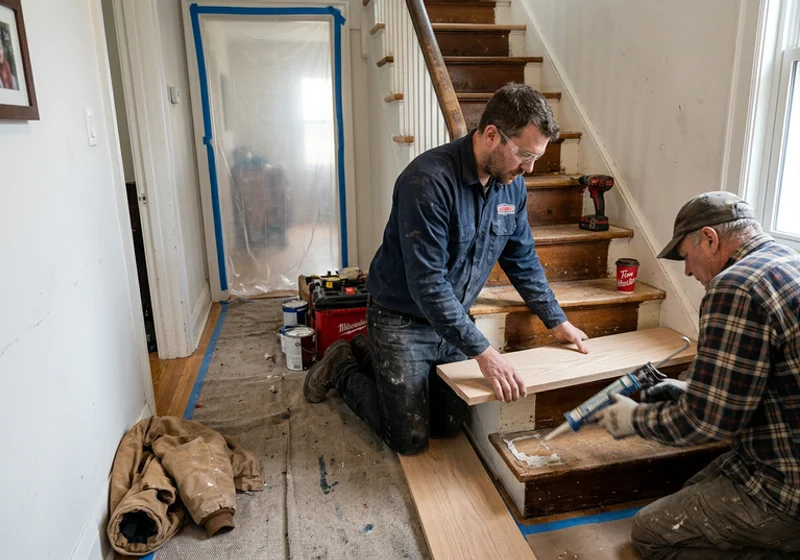
Radiused tread and riser replacement
New hardwood treads and risers get cut to the precise template of each individual step. We install these over your original stringers, provided they are still completely solid. The current preference for this upgrade is using Canadian white oak. This specific wood features a closed cellular pore structure, making it highly resistant to the moisture swings we see across Ontario.
Full curved staircase rebuild
New custom-bent stringers, radiused treads, and a continuous handrail are required when the original structure has cracked or sagged beyond repair. We build entirely new support ribs out of solid 7/8-inch material inside the box treads to stop future deflection. A tread that moves even 1/8 of an inch will eventually cause loud squeaks.
Curved handrail and baluster replacement
A new laminated handrail follows your exact curve, paired with iron or wood balusters set at individual angles. We strictly use vertical balusters for all our Toronto projects. The Ontario Building Code classifies horizontal bars as a climbing hazard, so our installers space the vertical half-inch iron bars exactly under 4 inches apart to keep your family safe and code-compliant.
Curved Staircase Cost Guide
Pricing your project depends on the specific materials you choose and the complexity of the radius. Our typical price band ranges from $18,000 to $45,000 per staircase. Recent 2026 supply data shows white oak carrying roughly a 12% price premium over red oak across Canada due to high demand.
| Cost factor | Toward $18,000 | Toward $45,000 |
|---|---|---|
| Stringers | Original, kept and repaired | New custom-bent stringers |
| Radius | Gentle arc | Tight radius, full sweep |
| Species | Red oak | White oak or walnut |
| Handrail | Short curved section | Long continuous rail with volute |
| Balusters | Kept or plain square bar | Decorative iron, individually angled |
For context, the Kingsway curved oak staircase featuring iron balusters was $28,000 over six weeks. We also completed a Rosedale Edwardian refinish and railing replacement for $16,500 over three weeks, primarily because most of the original structure stayed in place. Straight stair refinishing in Toronto usually starts around $100 to $130 per tread, but curved work requires custom forming that pushes the baseline higher.
When Does a Curved Stair Need Work?
Professionals look for specific structural warning signs during every home assessment. We find that a failing staircase will usually show its age through distinct movement and separation.
Signs a curved staircase needs attention:
- Treads that dip in the middle or feel soft near the outer stringer.
- Gaps opening between the treads and the wall-side stringer.
- A handrail that moves when you lean on it, or feels bumpy along the curve.
- Balusters that are loose, missing, or spaced wider than 4 inches (100mm).
- Earlier repairs with straight-cut parts that fail to follow the actual curve.
You should test your treads by stepping firmly on the outer edge. If you feel more than 1/8 of an inch of give, the internal support blocks have likely failed and need reinforcement.
Curved Renovation vs Straight Staircase Work
The entire installation process changes completely depending on the shape of your stairs. We can build straight components in a controlled shop environment, but a curve requires our team to bend the wood right in your hallway using a vacuum press.
| Curved staircase renovation | Straight staircase renovation | |
|---|---|---|
| Price | $18,000 to $45,000 | $6,500 to $14,000 |
| Fabrication | Templated and fitted on site | Cut in our Etobicoke shop |
| Timeline | 3 to 6 weeks | Part of 2 to 4 weeks overall |
| Supervision | Andriy personally | Senior crew lead trained by Andriy |
If you are planning an entirely new curved stair or a major change in shape, start by looking at our custom staircase design services. Many clients find it helpful to check the straight staircase renovation page for standard flights. We often see clients upgrade their curved railings with new iron balusters or custom wood stair railings.
Code and Permits on Curved Stairs
Curved stairs must strictly meet Ontario Building Code requirements to keep everyone safe. We ensure every project complies with Section 3.4.6, verifying these specific details:
- Tapered treads must have a minimum run of 150 millimetres at the narrow end.
- Handrails need to sit between 860 and 1070 millimetres high.
- Handrails must allow for continuous graspability without interruption.
Standard restoration work usually does not need a permit from the city. You will likely need a permit if the project replaces structural stringers or alters the actual rise, run, or headroom. We always tell you exactly which rules apply during your initial estimate, so contact us today to start your curved staircase renovation.