Have you ever felt a wooden step bounce a little too much under your feet? It is a scary feeling, especially when carrying groceries in the rain.
That is why Staircase Renovation Toronto provides a complete exterior stair rebuild for your home. We also handle deck stair replacement, front porch stair rebuilds, and side-entry step reconstruction throughout Toronto, ON.
This work is backed by 22 years of hands-on experience across the GTA. Every exterior job starts at the bottom.
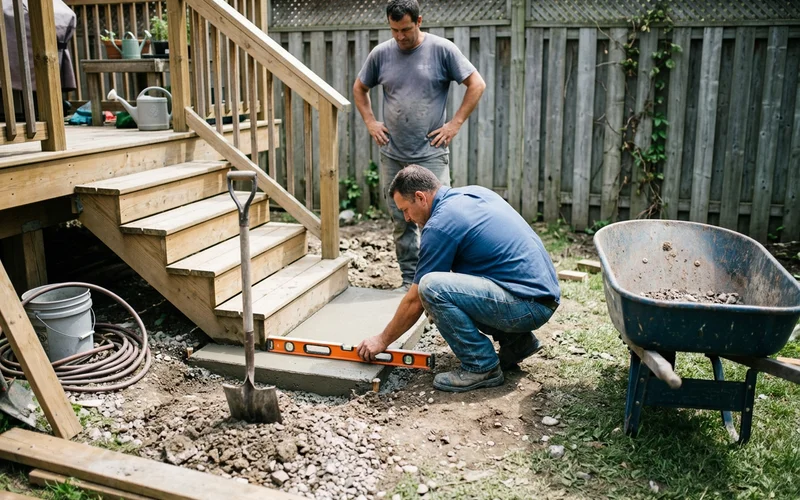
We check the footings, concrete piers, or pads for frost heave and inspect the stringer bases for rot before pricing the rest. The rebuild uses pressure-treated stringers and treads, stringer hangers fastened to the deck ledger, and a specific drainage detail that sheds water.
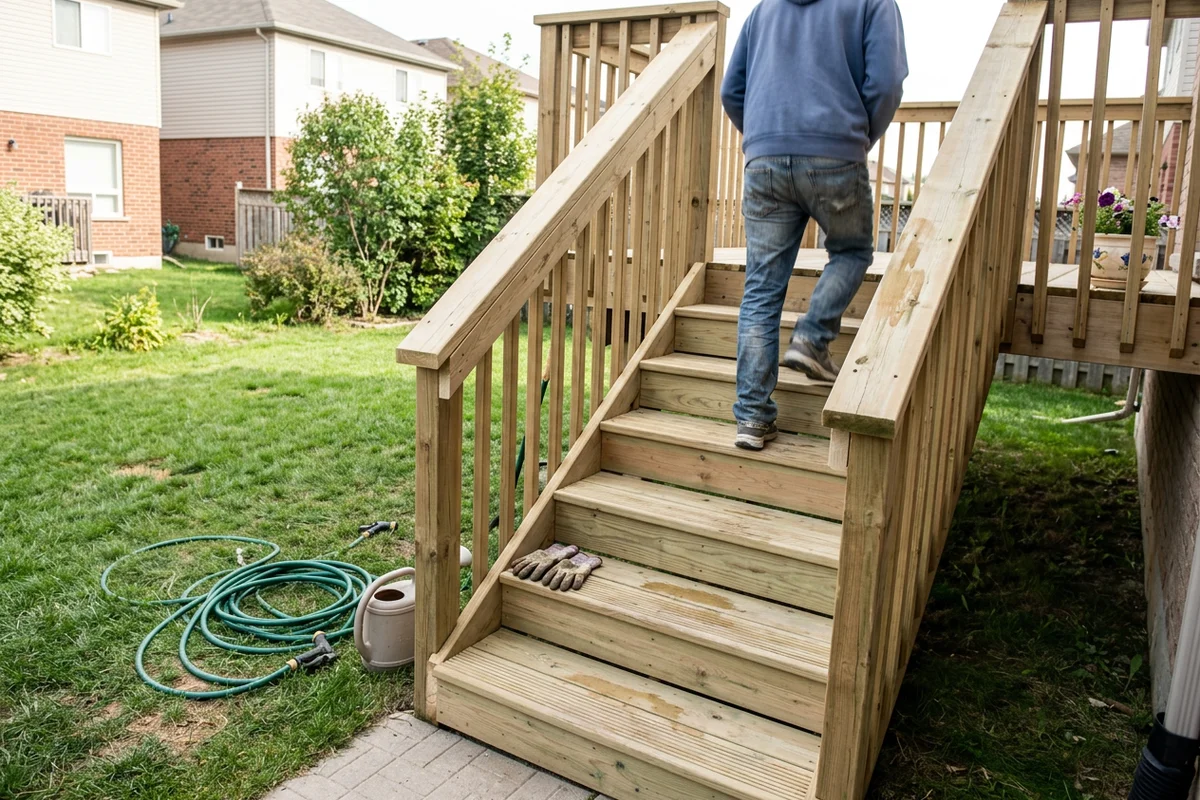
This approach adds a code-compliant guardrail and handrail fixed directly into the structure. The pickets are spaced to the 4-inch sphere rule to keep children safe, and the non-slip tread finish grips well in rain and light snow.
Composite treads are also available for a maintenance-free finish. Pricing runs $2,500 to $7,500 per exterior stair.
We will walk you through exactly how this works to ensure your steps last for decades. The guide below shows you the exact details.
Priya in Guildwood called about soft basement stairs and mentioned the back steps as an afterthought. When we looked, the back steps had rotted where the stringers sat on a sunken concrete pad, and the railing moved when you leaned on it. We rebuilt the back steps in pressure-treated lumber on a new pad with a proper guard, rebuilt the basement stair at the same time, and quoted it all together at $7,200. The price didn’t move.
What Is an Exterior Stair Rebuild?
An exterior stair rebuild replaces the stringers, treads, risers and railings of an outdoor stair, and fixes whatever is underneath it. Backyard deck stairs, front porch steps and side-door stairs to the basement landing are the most common in GTA homes.
Outdoor stairs fail differently from indoor ones. Water, freeze-thaw cycles and ground movement do most of the damage.
A rebuild that only replaces the visible wood often fails again in a few winters. The fix has to include the base.
The Hidden Dangers of Frost Heave
We see this structural failure all the time with shallow foundations. The Ontario Building Code requires deck footings to reach a minimum depth of 4 feet (1.2 metres) below grade.
This specific depth gets the concrete safely below Toronto’s frost line. Your steps will heave, shift, and crack if the footings sit even a few inches above this mark.
Types of Exterior Stairs We Rebuild
| Type | Common problems | What we fix |
|---|---|---|
| Deck stairs | Rot at stringer base, loose hangers | New stringers, hangers, pad or piers |
| Front porch steps | Tilting treads, heaved footings | Footings, stringers, treads, rail |
| Side-entry steps | Rot where steps meet grade | Base, stringers, guard |
| Stairs with landings | Sagging landing, weak posts | Landing framing, posts, piers |
Every type of staircase handles weather and weight a bit differently. You will notice that porch steps often tilt, while deck stairs tend to rot right where the wood meets the grass.
We always check your property against local regulations before starting any work. The City of Toronto requires a building permit for any attached deck or stair that sits more than 24 inches (600 mm) above the ground.
Bypassing this crucial step can lead to expensive fines or forced teardowns.
Exterior Stair Cost Guide
| Cost factor | Toward $2,500 | Toward $7,500 |
|---|---|---|
| Height | 3 to 5 risers | Tall deck stair with landing |
| Footings | Sound | New concrete piers or pad |
| Width | Standard | Wide porch stair |
| Treads | Pressure-treated | Composite |
| Railing | One handrail | Guards both sides plus handrail |
Budgeting for an exterior project requires looking at both the upfront price and the long-term value. A basic repair might seem cheap today, but a proper exterior stair rebuild prevents recurring issues.
Our team frequently recommends Canadian-made MicroPro Sienna pressure-treated wood for a great balance of cost and durability. This popular material typically lasts 15 to 25 years when properly maintained in our climate.
Upgrading to a composite material like Trex pushes the initial price higher but can extend the lifespan to 25 or even 50 years.
When Should You Rebuild Outdoor Stairs?
Waiting too long to replace damaged steps usually leads to a much bigger repair bill. You can catch most structural problems early by doing a quick visual inspection every spring.
- Treads tilt, bounce or have soft spots.
- The bottom of the stringers is dark, crumbly or sitting in water.
- A flathead screwdriver easily pushes deep into the bottom of the wooden stringer.
- The stair has pulled away from the deck or porch.
- The railing moves when you lean on it.
- Winter has visibly moved the stair from where it was.
We use a simple trick called the screwdriver test to check for hidden rot. Just press a metal tool against the bottom of the wood frame, and if it sinks in easily, the structural integrity is compromised.
Pressure-Treated vs Composite vs Repair Only
| Pressure-treated rebuild | Composite treads on treated framing | Spot repair | |
|---|---|---|---|
| Price | Lower in the band | Higher in the band | Lowest, short-term |
| Upkeep | Stain or seal every few years | Low | Ongoing |
| Fixes the base | Yes | Yes | Rarely |
Choosing the right material changes how much time you will spend maintaining your yard. Wood requires a bit of weekend labor, while synthetic boards practically take care of themselves.
We always remind homeowners that spot repairs rarely solve the root cause of a sagging step. If the stair leads down to a basement door, see basement staircase renovation.
For interior railing work, see wood stair railings.
Guards, Handrails and Freeze-Thaw
Exterior stairs follow the same Ontario Building Code rules for rise, run, handrails and guards as interior ones, plus they have to survive GTA winters. A sturdy handrail is your best defense against icy slips.
Our carpenters build every railing to meet strict provincial height standards. The building code requires a 36-inch (900 mm) guardrail when a deck sits between 24 inches and 5 feet 11 inches above the ground.
If your property slopes and the drop exceeds 5 feet 11 inches, that guardrail must increase to 42 inches (1,070 mm).
We plan the guard height, the handrail and the picket spacing with the rebuild, and we set the footings to resist frost heave so the new stair stays where we put it. This attention to detail guarantees your family stays safe year-round.
Contact us today to schedule your exterior stair rebuild and take the first step toward a safer, more beautiful outdoor space.